
In a bustling automotive manufacturing plant, Sarah, the production manager, faces a familiar challenge every quarter. Her leadership team needs to understand supplier performance, production line efficiency, and quality trends to make critical sourcing and operational decisions. But the data lives in a complex database with dozens of interconnected tables, and Sarah doesn’t have the SQL expertise to extract the insights she needs.
This isn’t just Sarah’s problem—it’s a widespread challenge in manufacturing. As Industry 4.0 transforms factories into data-rich environments, the gap between data availability and data accessibility has become a major bottleneck. Traditional Text-to-SQL solutions struggle with the complexity of manufacturing databases, the specificity of industrial terminology, and the analytical depth required for operational excellence.
That’s where the SQL-of-Thought framework combined with Agentic AI comes in—a breakthrough multi-agent approach that’s revolutionizing how manufacturers interact with their data and transform their supply chains.
At Quantisage, we’re not just observers of the supply chain evolution—we’re architects of its future. With over 20 years of experience delivering enterprise-grade technology and compliance solutions to regulated and performance-driven industries, we’ve witnessed firsthand the challenges that plague traditional supply chain management. That’s why we developed ChainSight AI: a next-generation platform designed to harness the power of agentic AI and transform supply chains from reactive to proactive, from fragmented to unified.
ChainSight AI is built on the principle that supply chains need more than just data—they need intelligent action. Our platform deploys a network of specialized AI agents, each an expert in its domain, working in concert to orchestrate the entire supply chain lifecycle. From forecasting and inventory management to procurement, compliance, and logistics, ChainSight AI agents don’t just analyze data—they act on it, making decisions in real time and adapting to changes as they happen.
What sets ChainSight AI apart is its human-centered design. We believe technology should empower people, not replace them. Our agents handle the routine, the complex, and the unpredictable, freeing your team to focus on strategic initiatives that drive growth. And because we understand that no two supply chains are alike, ChainSight AI is platform-independent, flexible, and scalable—ready to integrate with your existing systems, whether in the cloud, on-premises, or in a hybrid environment.
With ChainSight AI, Quantisage is building the next generation of supply chain management—one where AI agents are your partners in resilience, efficiency, and innovation.
Modern manufacturing environments generate vast amounts of data across multiple systems:
This data is stored in complex relational databases with intricate table relationships that require sophisticated SQL queries to analyze effectively. The complexity creates several key challenges:
Challenge 1: Database Complexity
Manufacturing databases typically contain 50-100+ interconnected tables with complex relationships that are difficult for non-technical users to navigate.
Challenge 2: Domain-Specific Terminology
Terms like “OEE” (Overall Equipment Effectiveness), “first-pass yield,” and “kanban systems” don’t translate directly to standard database structures.
Challenge 3: Analytical Depth Required
Manufacturing decisions require multi-table joins, time-series analysis, and complex calculations that go beyond simple queries.
Challenge 4: Real-Time Decision Making Operational teams need instant access to insights during production runs, not days later after data analysts have processed requests.
The SQL-of-Thought framework addresses these challenges through a sophisticated multi-agent architecture designed specifically for complex, domain-specific Text-to-SQL applications, now enhanced with agentic AI capabilities.
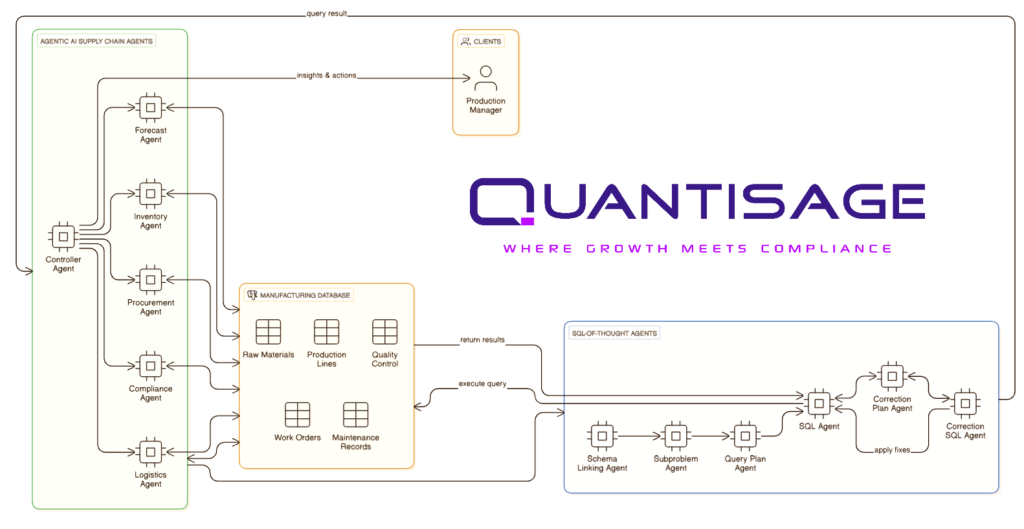
The multi-agent framework that systematically processes natural language queries and generates accurate SQL through specialized components, enhanced with autonomous decision-making capabilities.
The Specialized Agents
SQL-of-Thought Framework Agents:
Agentic AI Supply Chain Agents:
To understand how this works in practice, let’s examine a typical manufacturing database structure: Manufacturing Supply Chain Database Schema
Complex relational database structure typical of modern manufacturing environments.
This schema includes critical manufacturing tables:
Let’s walk through a real manufacturing use case that demonstrates the power of this technology.
The Business Question
“Show me the production efficiency for all lines in the Midwest region that manufactured Product X during Q3, including defect rates by raw material supplier and the impact of maintenance downtime on overall output.”
This query requires joining multiple tables and applying complex calculations that would typically take hours for a data analyst to write.
Step-by-Step SQL-of-Thought with Agentic AI Processing
Step 1: Schema Linking
The agent analyzes the natural language query and identifies the relevant tables:
Step 2: Subproblem Decomposition
The query is broken down into manageable components:
Step 3: Query Planning
A step-by-step execution plan is created:
Step 4: SQL Generation
The SQL Agent generates the complex query with proper joins, calculations, and aggregations.
Step 5: Agentic AI Analysis
The Controller Agent coordinates with other specialized agents:
Step 6: Error Correction (if needed)
If the query fails, the Correction Plan Agent uses the manufacturing-specific error taxonomy to diagnose issues like:
Manufacturing environments have unique error patterns that generic Text-to-SQL systems miss. The SQL-of-Thought framework includes a specialized error taxonomy for manufacturing:
Comprehensive classification of SQL errors with manufacturing-specific categories.
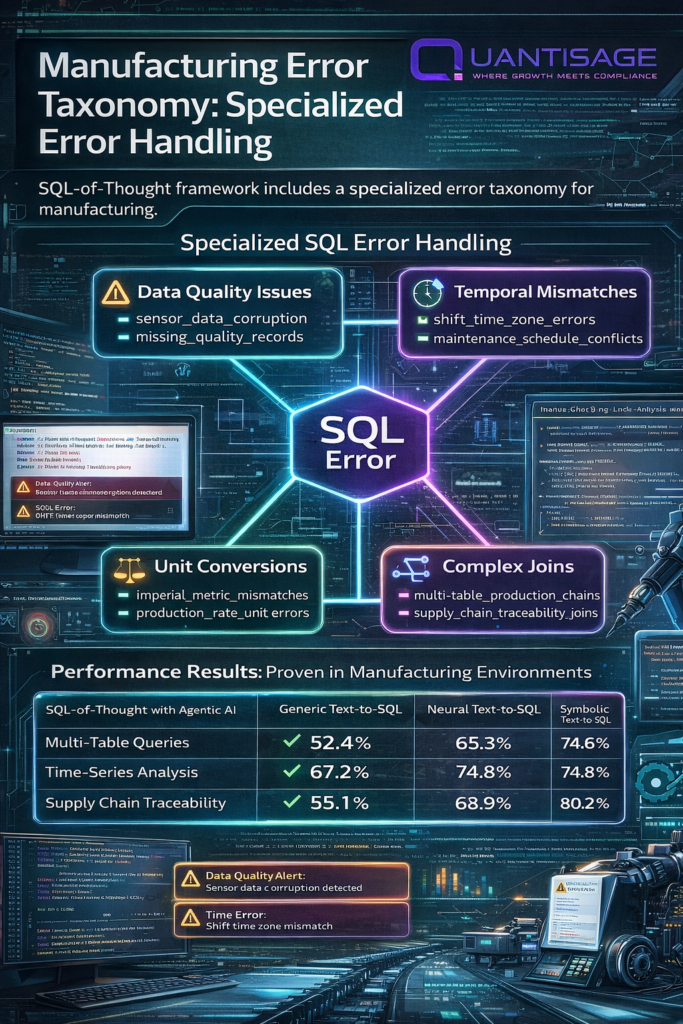
Manufacturing-Specific Error Categories:
The SQL-of-Thought framework combined with Agentic AI has demonstrated exceptional performance in complex, real-world manufacturing scenarios:
Table 1: Execution Accuracy of prior methods and SQL-of-Thought with Agentic AI
Comparison of performance across different Text-to-SQL approaches.
For manufacturing-specific benchmarks, SQL-of-Thought with Agentic AI achieved:
Table 2: Execution Accuracy Results for Manufacturing Datasets
Impact of different framework components on accuracy.
Key Findings:
After implementing SQL-of-Thought with Agentic AI, Sarah can now answer complex manufacturing questions in real-time:
Before SQL-of-Thought with Agentic AI:
After SQL-of-Thought with Agentic AI:
The SQL-of-Thought framework with Agentic AI transforms manufacturing analytics by:
1. Empowering Operational Teams
Production managers, quality engineers, and supply chain professionals can access insights directly without SQL expertise.
2. Reducing Dependency on Data Teams
Complex queries no longer require data analyst intervention, freeing up valuable resources.
3. Improving Response Times
Real-time analysis of production issues and quality problems enables immediate corrective action.
4. Enhancing Decision Making
Data-driven decisions across the manufacturing value chain improve efficiency, quality, and profitability.
5. Standardizing Analytics
Consistent, reliable queries across the organization ensure everyone is working with the same accurate data.
6. Autonomous Supply Chain Coordination
Agentic AI components enable seamless coordination between planning, sourcing, production, inventory, logistics, and compliance functions.
The SQL-of-Thought framework with Agentic AI continues to evolve with manufacturing-specific enhancements:
Building a robust Text-to-SQL agent for manufacturing requires specialized knowledge of both database structures and manufacturing operations. The SQL-of-Thought framework combined with Agentic AI addresses this gap by combining multi-agent architecture with domain-specific error handling and autonomous decision-making capabilities, making sophisticated manufacturing analytics accessible to everyone.
This technology represents a paradigm shift in how manufacturers leverage their data, transforming complex database queries into natural language interactions and empowering operational teams to make data-driven decisions that improve efficiency, quality, and profitability.
The future of manufacturing is data-driven and autonomous, and tools like SQL-of-Thought with Agentic AI are making that future accessible to everyone on the factory floor and throughout the supply chain.
Organizations adopting this combined approach can achieve:
These improvements are not tied to any particular vendor — they result from the agentic architecture itself.

We have the experience, knowledge, and flexibility to help you with business transformation, hybrid workplace strategy, technology implementation and adoption, and more.

Join the like minded community and get the latest updates and news on business, technology and digital to help improve your business.
