
Quantisage Announces Readiness for Oracle AI Database 26ai and Oracle’s Autonomous AI Lakehouse Expansion. Click here to see the news. ×

Data Modernization Strategy for Oracle Customers: A Practical Roadmap for Transforming Legacy Environments on OCI  

Share

Oracle customers face a common challenge: legacy databases, siloed systems, fragmented reporting, and outdated analytics structures cannot keep up with modern business needs. 

A well-defined Data Modernization Strategy on Oracle Cloud helps organizations transition from aging infrastructure to a unified, scalable, AI-powered architecture on OCI. 

This blog outlines a practical roadmap that combines business objectives, technology modernization, and Oracle-native services to deliver measurable outcomes. 

1. Why Organizations Must Modernize Now 

Common challenges among Oracle customers: 

  • High cost of on-prem hardware and maintenance 
  • Limited scalability for analytics workloads 
  • Slow batch ETLs leading to delayed decision-making 
  • Disconnected BI and operational systems 
  • Growing demand for predictive and real-time insights 
  • Regulatory and compliance pressures 
  • AI and GenAI readiness gaps

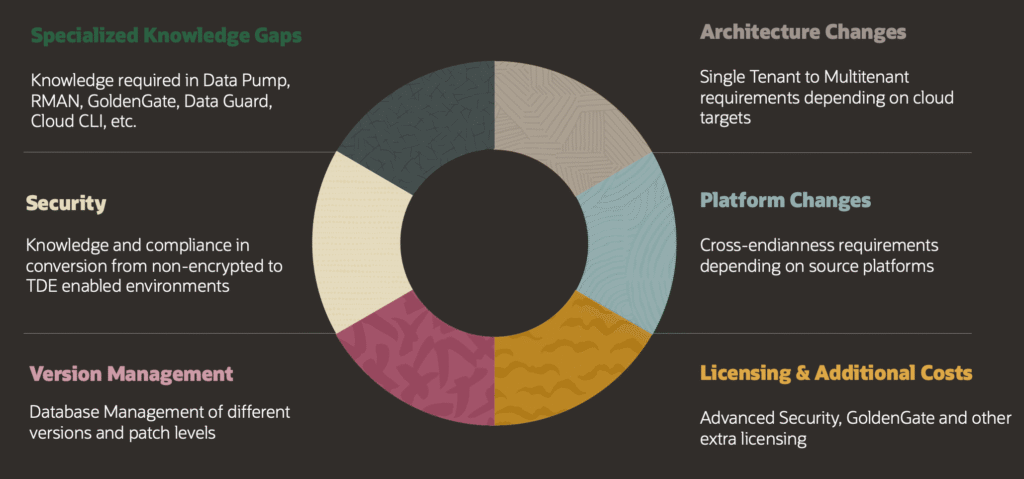
Common Cloud Migration Challenges 

Cloud migrations can pose different challenges and become a rather cumbersome journey. The following are only some of the challenges that customers face during their cloud migrations: 

Specialized Knowledge Gaps 

  • Teams of dedicated professionals with knowledge of products such as Oracle Database, Oracle Analytics, Recovery Manager (RMAN), Data Guard, GoldenGate, Cloud command line, and much more are required. 

Security 

  • In-depth knowledge of security and compliance for database deployments and expertise in implementing Transparent Data Encryption environments are needed. 

Version Management 

  • Database fleets comprise tens to hundreds of databases with different versions and patch levels, resulting in inventory management and target version challenges for migration projects.

Architecture and Platform Changes 

  • Oracle Database has different configurations, ranging from a single instance to Oracle RAC, non-container to multitenant environments, and different endianness. Knowledge of how to convert between different architectures is required for migration projects. 

Licensing & Additional Costs 

Using products required for a migration project might require additional licensing, which could increase the budget. 
2. The Three Pillars of Oracle Data Modernization 

Pillar 1: Modernizing Core Databases 

Options include:

  • Lift-and-Shift to OCI Compute
  • Move to Exadata Cloud Service / ExaC@C 
  • Migrate to Autonomous Database 

Outcomes: 
Reduced administrative effort
Improved performance
Lower TCO
Scalable infrastructure

Pillar 2: Building a Unified Analytics Platform 

This involves creating a modern data Lakehouse using:

  • Object Storage 
  • ADW
  • GoldenGate
  • Data Flow
  • Data Integration
  • Data Catalog
  • Oracle Analytics Cloud

Outcomes:
Streamlined reporting
Centralized data foundation
Real-time analytics
Trusted, governed data

Pillar 3: Enabling AI, ML, and GenAI Adoption 

Leveraging: 

  • OCI Data Science
  • ADW ML
  • Vector Search (Oracle 23ai)
  • AI Services

Outcomes: 
Predictive intelligence 
Faster model development
Enterprise GenAI readiness
3. A Structured Modernization Roadmap 

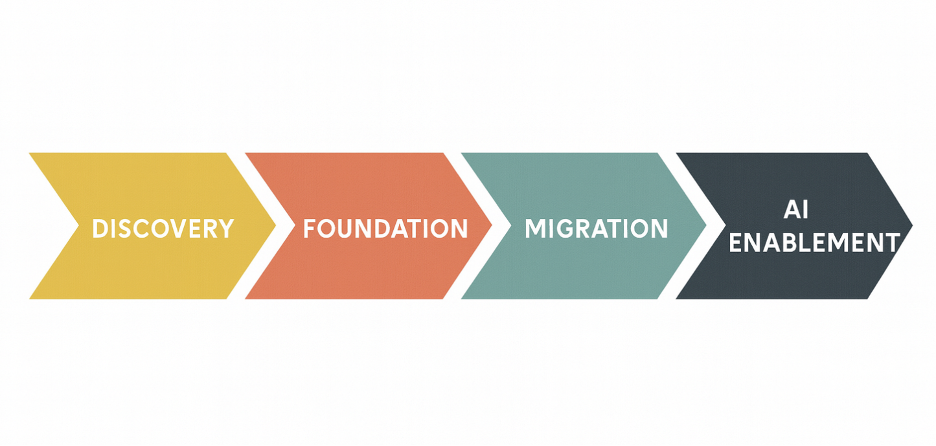
4-Phase Modernization Roadmap 

Phases: Discovery → Foundation → Migration → AI Enablement 

Phase 1: Assessment & Strategy 

  • Architecture review
  • ROI/TCO analysis
  • Modernization blueprint

Phase 2: Platform Foundation 

  • CIS Landing Zone & Compartment architecture
  • VCN & security
  • Object Storage Lake zones
  • Governance & metadata

Phase 3: Migration & Modernization 

  • Database migration
  • ETL modernization
  • Data model transformation
  • BI & reporting migration

Phase 4: AI & Analytics Expansion 

  • ML pipelines
  • Forecasting models
  • GenAI integration

4. Business Use Cases by Industry 

Retail & CPG 

  • Real-time inventory visibility
  • Demand forecasting
  • Promotion analytics

Financial Services 

  • Risk scoring
  • Fraud detection
  • Customer segmentation

Healthcare 

  • Claims analytics
  • Care insights
  • Operational intelligence

High Tech 

  • Telemetry analytics
  • Product usage intelligence

5. Outcomes Delivered 

Customers achieve: 

  • Faster analytics (20–40× improvement)
  • Lower cost (30–60%)
  • Unified, governed data foundation
  • Scalable AI capabilities
  • Improved decision-making speed
  • Reduced operational complexity

Why Work with Us

We bring deep expertise in: 

  • Oracle Cloud Infrastructure, SaaS & PaaS
  • Exadata migrations
  • Data Lakehouse architecture
  • GoldenGate/ETL modernization
  • Autonomous Database
  • Modern BI and ML
  • AI & Vector Search solutions

We deliver strategy → architecture → implementation → analytics → AI enablement

Conclusion 

Modernization is no longer optional—it is a strategic enabler for growth, innovation, and competitive advantage. By adopting our proven OCI modernization strategy, Oracle customers can transform their legacy environments into high-value, AI-ready platforms that meet today’s demands and tomorrow’s opportunities. 

Choosing the right platform on Oracle Cloud is more than just rehosting — it’s about architecting for the future.

  • Use OCI Native VMs as your modernization foundation
  • Use OCVS where VMware continuity is critical
  • Use OKE or OpenShift when you’re ready for container-native evolution
  • Use OCI Database Services for Cost, Performance, Auto Scaling and Disaster Recovery

Beyond technology choices, CTOs increasingly weigh broader business and operational factors: 

  • Cloud economics – reduce TCO through efficient resource utilization and pay-as-you-go models. 
  • Ease of management – leverage managed OCI services to simplify operations. 
  • Portability – ensure workloads are not trapped in proprietary formats. 
  • Avoiding vendor lock-in – maintain flexibility to evolve your architecture. 
  • Ease of scaling – quickly adapt to changing demands. 
  • Smaller, more efficient teams – reduce operational overhead through automation. 

Making OCI’s native and cloud-native platforms makes a more future-ready choice. 

Cloud transformation is not a single event — it’s a strategic journey. The most successful organizations continuously evolve their platforms, ensuring each step aligns with business goals, performance needs, and long-term agility. 

We partner with organizations to accelerate this transformation end-to-end. 

Partners and Associates at Quantisage have been helping with Digital transformation projects for over 25 years. We are dedicated to making the transitions as seamless as possible. With our comprehensive services, from assessment and planning to training and support, we ensure that our clients achieve the results and capabilities that drive their business forward. 

Contact us today for your Cloud and Digital transformation strategic journey.

Additional Resources 

Quantisage’s Oracle Cloud Infrastructure 
Quantisage’s Database Management 
Oracle Cloud Infrastructure  


Author

Sanket Sheth
Sanket Sheth
Managing Partner- Technology & Cloud Solutions

Sanket drives Quantisage’s technology strategy, architecture excellence, and enterprise modernization services. He blends deep technical expertise with strong business development leadership, positioning Quantisage as a trusted partner for cloud, data, and AI transformation.

Sanket brings a broad and impactful track record across Oracle, OCI, Azure, multi-cloud, modern data platforms, Exadata, workload & database migrations, modernization frameworks, and AI engineering. Leading Technology Strategy, Solutions Delivery, and Business Development

Oracle. Cloud. Data. AI. Delivered.

Book Time with Me

Let’s get to work together.

We have the experience, knowledge, and flexibility to help you with business transformation, hybrid workplace strategy, technology implementation and adoption, and more.

Talk to an Expert